Black Country Bites Back

Freya Smith

Yvonne Thomas and Walsall Animal Action

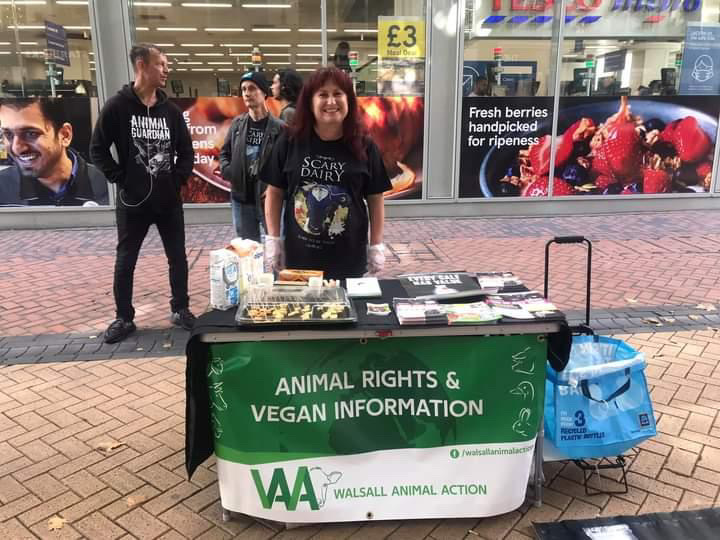
Outside a McDonald’s on a grey day in Walsall, there’s a group intent on saving animals—one conversation at a time. With their unapologetic Black Country accents and the persistence of righteous evangelists, they offer leaflets and vegan food samples to anybody who will listen. They are all smiles, even as a group of mocking teens wave burgers in their faces. This is Walsall Animal Action, bringing militant veganism to the streets of the West Midlands.

I sat down with Yvonne Thomas in a cosy Walsall café to learn more about their mission. Wearing a black hoodie with WAA printed on it, and with a beaming smile, Yvonne set me at ease straight away. She’s been the group’s leader for six years, and her experience shows through in her calm, reasoned persuasiveness. I’m a vegetarian, but by the end of our conversation I found myself reconsidering my own choices. “Dairy is just as scary,” Yvonne says. Her stories of cruelty and injustice to animals left me devastated.

Along with the rest of WAA, Yvonne takes inspiration from figures like Juliet Gellatley, founder of animal rights charity Viva!, and Australia-born activist Joey Carbonstrong, who describes himself as an “ex gang member who turned his life around and is now a vegan animal rights activist.” Carbstrong in particular has been known to use eye-catching tactics that get him in trouble. He and six other activists were arrested in 2024 for occupying part of a sausage factory, what he called a “gas chamber,” where carbon dioxide is used to stun pigs before they are slaughtered.

For Yvonne, the mission is clear. Everything WAA do is for the animals and for our planet. “All animals want to live,” she tells me. There’s no denying that. Yet millions are being killed every year in the UK, as well as around the world. More than 900,000 pigs were slaughtered just this March alone, according to the UK’s Agricultural and Horticultural Development Board.

Yvonne can pinpoint the moment when she became a vegan. On a childhood visit to Shugborough Hall’s model farm, seeing a distressed calf separated from its mother forced her to reconsider the dairy industry. Cows have to be regularly pregnant in order to produce milk, but calves are usually taken away soon after birth. Not everyone has an epiphany like Yvonne’s, though. Part of WAA’s job is to spread the word to curious meat-eaters—and to vegetarians like me.
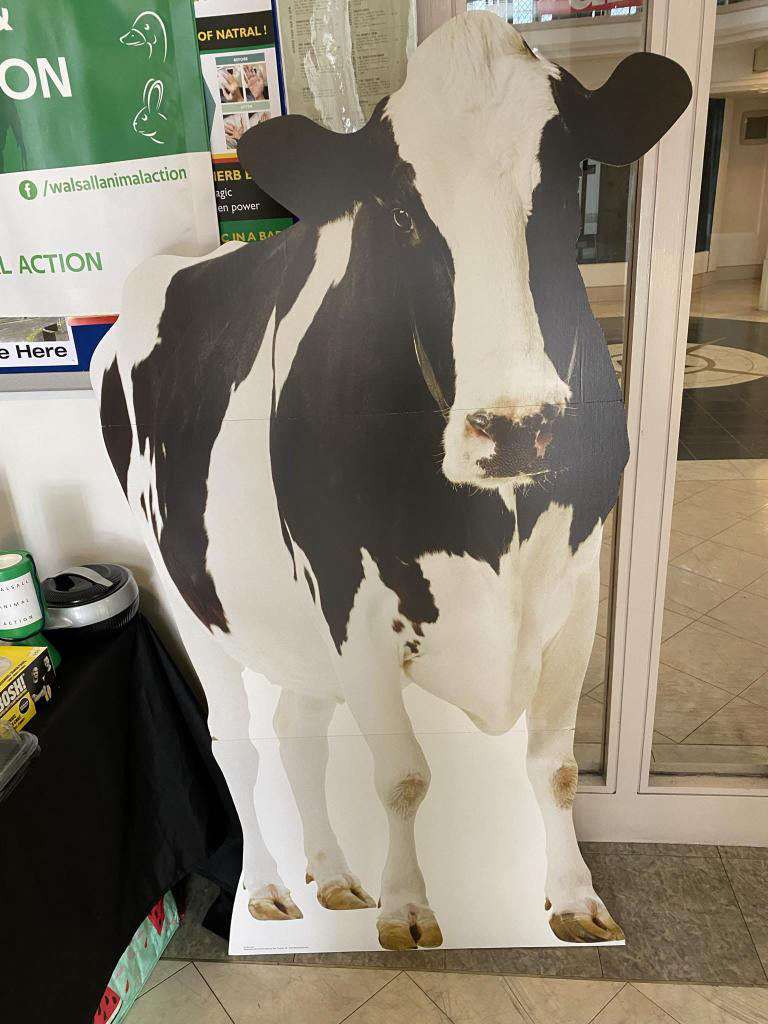
A cardboard cut-out of a cow (courtesy of WAA)

Noon on the first Saturday of a chilly, dreary December, and the group have moved to St Paul’s Church. It’s warmer and more welcoming than their spot outside McDonalds, and suitable for their peaceful purposes. The caretaker sets up their stall, slightly confused by the life-sized cut-out of a cow.

Carolyn ventures outside, encouraging people to enter the church and sample their range of free vegan foods. It’s the festive period, so the food is tailored to suit the season: plant-based milks, vegan cakes, vegan cheese. The response is so immense that people come back for more, and the group have soon run out of samples.

A man who is trying to eat healthier takes a free cookbook. A teenage girl hoping to make a difference grabs a handful of free leaflets. Even the vicar wanders down to support the cause. There is a true sense of community spirit. But the group know they can do more. Already, they are looking ahead to Veganuary and contemplating how they can improve their stall for next time.

When WAA are out campaigning, people sometimes challenge them with awkward questions. The group has a practiced approach to such conversations. First question: “Would you eat your pet dog?” Yvonne says there is no difference between a dog and a sheep, between a dog and a cow, between a dog and a pig. They all want to live, and yet they can’t defend themselves when the industry decides their time is up.

Then people shout, “veganism makes you weak!” It’s an association Yvonne and her team work tirelessly to break. One effective response, they have found, is to point to Lewis Hamilton—vegan since 2017—and numerous vegan bodybuilders. They even have cardboard cut-outs they can literally point to.

WAA’s work isn’t only about food and agriculture. They also stand against animal testing, fur clothing, trophy hunting, badger culls, and more. The group have embarked on animal rights marches in Birmingham, including one in memory of Cecil the Lion, killed with a bow-and-arrow by a tourist in 2015. They have also carried money boxes around Walsall, encouraging visitors to donate to organisations which support the rescue of animals, including the Wolverhampton-based Garden Sanctuary.

Overall, the response is positive. Their non-judgemental, peaceful approach evokes a welcoming atmosphere. They don’t shy away from awkward conversations. The more uncomfortable we feel, the more we learn. WAA hope to be a “local group with a friendly face,” inspiring people across the Black Country to alter their lifestyles. There’s a long way to go, and a lot of animals to save. But you have to start somewhere. It starts with what’s on your plate.

This Article Appears In

Tower Volume 3 Spring 2026