The Struggle for Identity in Britain’s Newest City

James Bull

Most towns form organically, shaped over hundreds of years by the push, pull, and grind of slow-moving historical forces. What happens, then, when a town is built from the ground up within a decade, a shell waiting to be inhabited, without a distinct identity, yet offering a clean slate upon which one might be inscribed?

This is Milton Keynes, the city I’ve lived in my entire life.

Established in 1967, Milton Keynes was intended to serve as an overflow for London—a commuter’s haven. Since then, it has come to be known mostly for its endless glass panels, roundabouts, concrete, and lack of soul. Its uniformity and colour palette evoke Soviet-era eastern Europe more than the home counties countryside, a borrowed and outdated vision of the future. The city centre is perhaps most symptomatic of the lack of identity so often associated with the city. Only the street signs distinguish it from any other struggling twenty-first-century British high-street.

But there is more to Milton Keynes than this. Strike out into its neighbourhoods, talk to its people, encounter it with open eyes and you might find that Britain’s newest city has developed a distinct sense of identity after all. Centring on greenery, adaptability and innovation, this is the Milton Keynes that has been quietly emerging since the 1960s, the city even I wasn’t quite sure really existed.

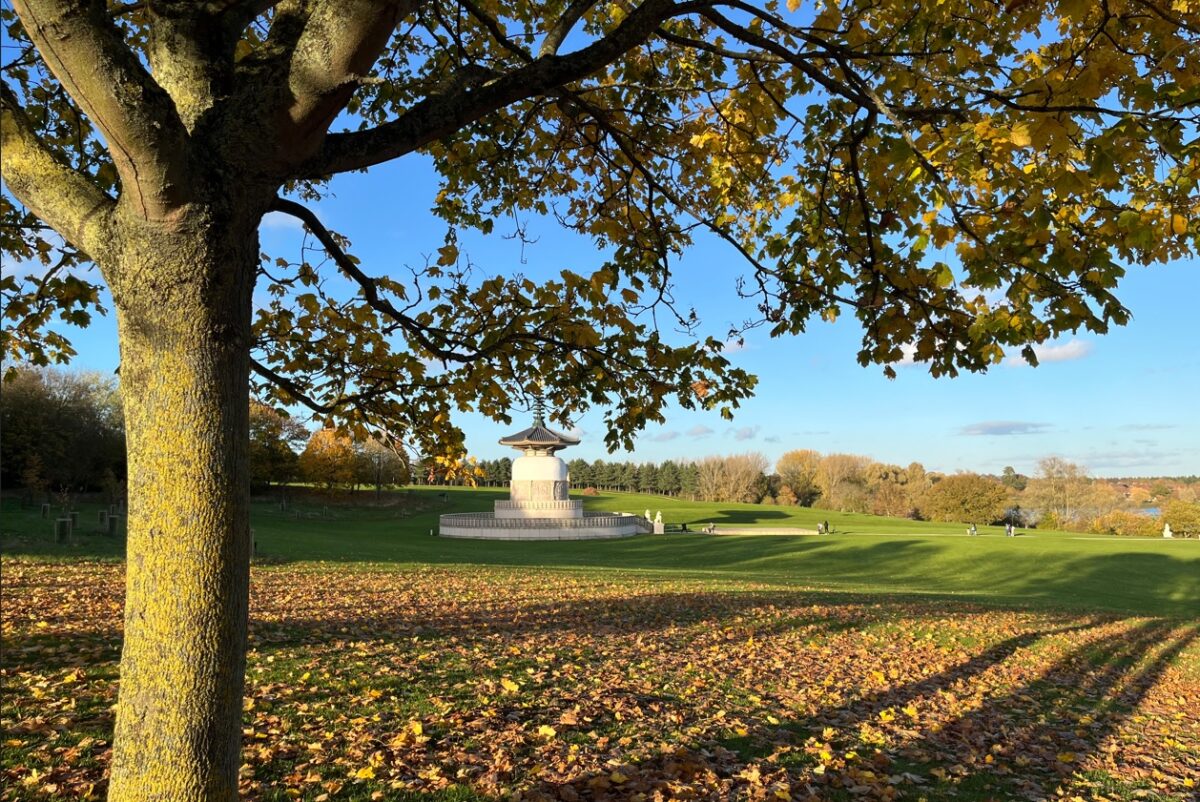
The Peace Pagoda at Willen Lake, Milton Keynes (photo by the author)

“Artificial definitely doesn’t mean bad”

Let’s start by tackling the main issue head on. Milton Keynes is indeed an artificial city. Even its picturesque lakes are man-made, constructed in the 1980s. Hardly anything you’ll see is more than seventy years old. Yet walking around Willen Lake on a sunny autumn day, accompanied by birdsong and the rustling of trees, you’d be hard pressed to find anything artificial about the experience. Surrounded by greenery and wildlife, the place feels perfectly natural.

“Artificial definitely doesn’t mean bad,” says Max, a lifelong resident who cites the city as a direct inspiration for his career in urban planning. He sits on a lake-facing bench, spending his lunch break a short bike-ride away from his city-centre office. “You’ll struggle to find a more seamless blend of green space and the amenities of a city, and that’s intentional.” Max tells me how his study of urban planning deepened his appreciation for Milton Keynes’s layout. “It’s not even wilful ignorance about the artificiality of it all—I just don’t care. The fact that the lakes and parks are features of town planning doesn’t make them any less enjoyable.”

It’s true that, surrounded by trees and grass, this area of Milton Keynes is a far cry from the images most people conjure when they picture the city. The greenery continues as I depart from Willen Lake and pass through Campbell Park, and before long I find myself arriving at the city centre.

Just ahead looms the Xscape, once the largest indoor ski dome in Europe and another contentious feature of Milton Keynes’s character. The whirring of the cooling system permeates the air, and the greasy smell of fast-food lingers in my nose. There’s a distinctly urban feeling about the place—you wouldn’t believe I’d been surrounded by trees just five minutes earlier.

“People are quick to criticise anything that’s different. I think that applies to Milton Keynes as a whole,” says Andrew, a retired teacher who moved here in 1984. He sits outside a Wetherspoon pub in the Xscape, smoking a cigarette with a pint of Worthington’s. It’s his favourite, he tells me.

Andrew finds the idea of Milton Keynes lacking identity almost exasperating. “It’s always had identity. Being modern is its identity, and it still is—look at those robots you see everywhere.” It’s true that the city has been at the forefront of advances in the automation industry. When San Francisco-based tech company Starship introduced its fleet of last-mile delivery robots in 2018, it brought them to Milton Keynes first. Self-driving shuttle buses, designed in New Zealand, were trialled extensively just last year.

“It’s easy to say that Milton Keynes can’t compare to somewhere like Bristol or Manchester,” says Andrew. “That’s obvious. Those places have had a few hundred years’ head start!” He’s convinced that Milton Keynes is catching up, though. Having existed as we know it for less than a single human lifetime, the city is still in its cultural infancy. “Culture is people. Everyone that moves here brings a bit of culture from where they’re from. I suppose the real culture here will be decided by the next generation. It’ll be an amalgamation of cultures from all over the place, and I think that’s an excellent idea.”

Andrew gestures towards the fourteen-floor Hotel La Tour, situated over the road. The reflective tiles that cover the building shine blue against the clear sky—at least one thing in the centre isn’t grey. “I do wish they’d stop constructing massive buildings like that. It didn’t used to be like this in the centre.” He’s right. When Milton Keynes was built, no structure was allowed to be taller than the tallest tree. This principle has been abandoned in recent years, with a thirty-three-storey block of flats approved last spring. The Council insists the development will give Milton Keynes “more landmark buildings,” but many longtime residents would rather they stayed faithful to the original vision of a city in the trees.
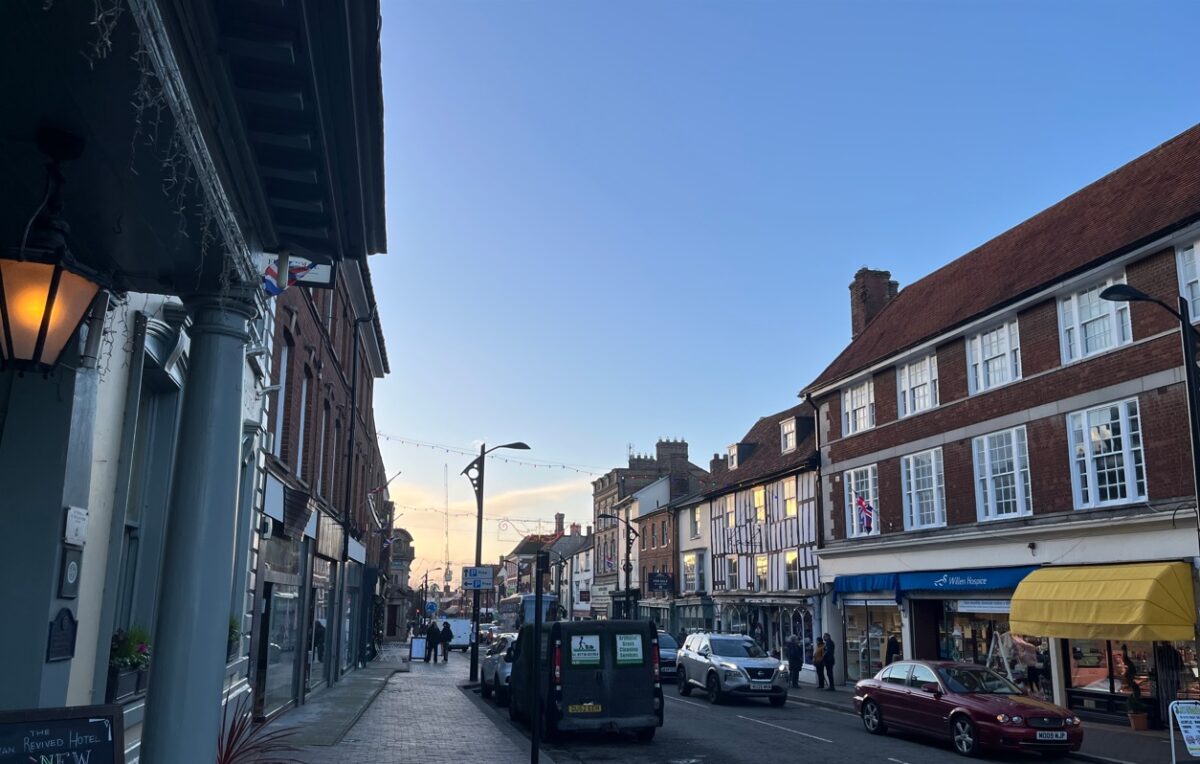
High Street at Newport Pagnell (photo by the author)

“My town doesn’t fit that stereotype at all”

Leaving the centre by bus (the council has promised a tram system somewhere in the city’s future), I set off for Newport Pagnell, a town on the city’s northern edge, notable for being the home of Aston Martin and for its rich English Civil War history. With central Milton Keynes largely a hub for work and leisure, most residents live in nearby towns like this one, which predate the city centre by centuries. If it’s history and culture we’re searching for, perhaps we ought to look here.

“Newport is a historic town, so when people say that MK has no history and include us in that, it annoys me to be honest,” says Emma, who has lived in Newport Pagnell her whole life. “People love to laugh about how boring and fake Milton Keynes is, and being lumped in with that does wear thin, especially when my town doesn’t fit that stereotype at all.”

Emma feels that Newport Pagnell is the ideal compromise between urban living and rural charm. She and her daughter often make weekend visits to nearby villages for tea and cake, followed by a walk. “You drive ten minutes in one direction and you’re in the heart of the centre, but ten minutes in the other and you’ll end up in a quiet little village with sheep roaming around.”

It’s clear that her daughter, six-year-old Millie, enjoys the accessibility of rural charm too. “It’s the best for bird feeding and I like how many horses there are!” she grins. “There really is a lot to be proud of here,” Emma continues. “The primary schools are great, and living in Newport means Millie’s in catchment for three secondary schools. It was important to me that my daughter should have access to all sorts of experiences growing up, and I think Milton Keynes has been the best place to provide that.”

Access to schools and housing in the city is only growing, with Newport Vale—a new housing development comprising over 800 new homes, along with multiple schools and a medical practice—being built within walking distance of Newport Pagnell. Developments like these (of which there have been several in recent years) will all contribute to Milton Keynes’s rapid growth: from roughly 40,000 people when the city was created, it’s expected to hit ten times that by 2050.

Newport Pagnell bears all the hallmarks of a historic town, unsurprising given that the community has been a named settlement since 1086. There is a distinct sense of identity—of continuity—in the town high street, which is populated by charity shops, old coaching inns, and hairdressers. No two buildings are the same, and there is no indication of the concrete expanse located three miles away.

For many residents like Emma, Newport Pagnell embodies balance, offering a lifestyle defined by access to both history and modernity. This duality represents a version of Milton Keynes that outsiders might not think to look for—a version in which the city serves to make everyday life more convenient and varied, rather than to define it. This dynamic is far from unique and can be found in many of the towns and villages that encircle central Milton Keynes. Look only to Bletchley (home of Alan Turing’s codebreaking efforts) for further examples of history and identity coexisting with the innovation of the city.

“Better by Design”

The wide variety of lifestyles that co-exist within the boundaries of Milton Keynes are characteristic of its deliberate flexibility. Critics fixate on the concrete and roundabouts, but for those that call it home, Milton Keynes is corridors of green within urban cityscapes, artificial lakes that feel anything but, and old towns—steeped in identities of their own—that ground modernity in rich, longstanding tradition.

What the city will become is yet to be determined. Its identity is still caught up with that fluidity and possibility. While I have no doubt Milton Keynes will forever be contentious, and that the stereotypes surrounding it will outlive the flaws upon which they are based, it’s easy to see why those that live here are so optimistic for the future.

The question, therefore, shouldn’t be whether Milton Keynes has an identity—of course it does. Instead, we should wonder how Milton Keynes, a city that refuses to be defined by a single trait, will continue to shape and reinvent its identity going forward.

This Article Appears In

Tower Volume 3 Spring 2026