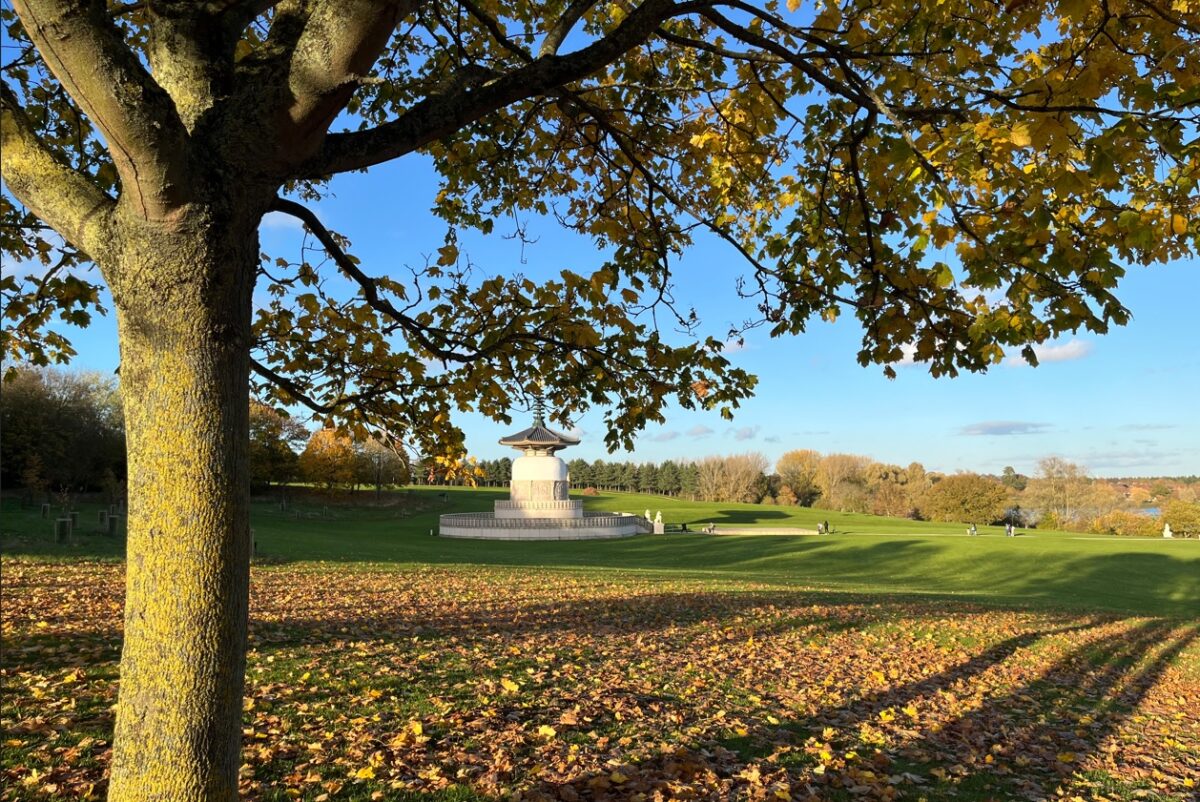
Let’s start by tackling the main issue head on. Milton Keynes is indeed an artificial city. Even its picturesque lakes are man-made, constructed in the 1980s. Hardly anything you’ll see is more than seventy years old. Yet walking around Willen Lake on a sunny autumn day, accompanied by birdsong and the rustling of trees, you’d be hard pressed to find anything artificial about the experience. Surrounded by greenery and wildlife, the place feels perfectly natural.
“Artificial definitely doesn’t mean bad,” says Max, a lifelong resident who cites the city as a direct inspiration for his career in urban planning. He sits on a lake-facing bench, spending his lunch break a short bike-ride away from his city-centre office. “You’ll struggle to find a more seamless blend of green space and the amenities of a city, and that’s intentional.” Max tells me how his study of urban planning deepened his appreciation for Milton Keynes’s layout. “It’s not even wilful ignorance about the artificiality of it all—I just don’t care. The fact that the lakes and parks are features of town planning doesn’t make them any less enjoyable.”
It’s true that, surrounded by trees and grass, this area of Milton Keynes is a far cry from the images most people conjure when they picture the city. The greenery continues as I depart from Willen Lake and pass through Campbell Park, and before long I find myself arriving at the city centre.
Just ahead looms the Xscape, once the largest indoor ski dome in Europe and another contentious feature of Milton Keynes’s character. The whirring of the cooling system permeates the air, and the greasy smell of fast-food lingers in my nose. There’s a distinctly urban feeling about the place—you wouldn’t believe I’d been surrounded by trees just five minutes earlier.
“People are quick to criticise anything that’s different. I think that applies to Milton Keynes as a whole,” says Andrew, a retired teacher who moved here in 1984. He sits outside a Wetherspoon pub in the Xscape, smoking a cigarette with a pint of Worthington’s. It’s his favourite, he tells me.
Andrew finds the idea of Milton Keynes lacking identity almost exasperating. “It’s always had identity. Being modern is its identity, and it still is—look at those robots you see everywhere.” It’s true that the city has been at the forefront of advances in the automation industry. When San Francisco-based tech company Starship introduced its fleet of last-mile delivery robots in 2018, it brought them to Milton Keynes first. Self-driving shuttle buses, designed in New Zealand, were trialled extensively just last year.
“It’s easy to say that Milton Keynes can’t compare to somewhere like Bristol or Manchester,” says Andrew. “That’s obvious. Those places have had a few hundred years’ head start!” He’s convinced that Milton Keynes is catching up, though. Having existed as we know it for less than a single human lifetime, the city is still in its cultural infancy. “Culture is people. Everyone that moves here brings a bit of culture from where they’re from. I suppose the real culture here will be decided by the next generation. It’ll be an amalgamation of cultures from all over the place, and I think that’s an excellent idea.”
Andrew gestures towards the fourteen-floor Hotel La Tour, situated over the road. The reflective tiles that cover the building shine blue against the clear sky—at least one thing in the centre isn’t grey. “I do wish they’d stop constructing massive buildings like that. It didn’t used to be like this in the centre.” He’s right. When Milton Keynes was built, no structure was allowed to be taller than the tallest tree. This principle has been abandoned in recent years, with a thirty-three-storey block of flats approved last spring. The Council insists the development will give Milton Keynes “more landmark buildings,” but many longtime residents would rather they stayed faithful to the original vision of a city in the trees.